


What It Means for the Global Solar Industry
The global solar industry is entering a new phase of policy-driven transformation in 2026. Governments across the United States, Europe, and Asia are accelerating renewable deployment through updated incentives, carbon reduction targets, and domestic manufacturing support programs.
As the solar market continues to mature, policy shifts are now focusing not only on installation growth but also on energy storage integration, grid modernization, and supply chain localization.
For businesses, distributors, and investors, understanding these regulatory changes is essential to staying competitive in the evolving renewable energy landscape.
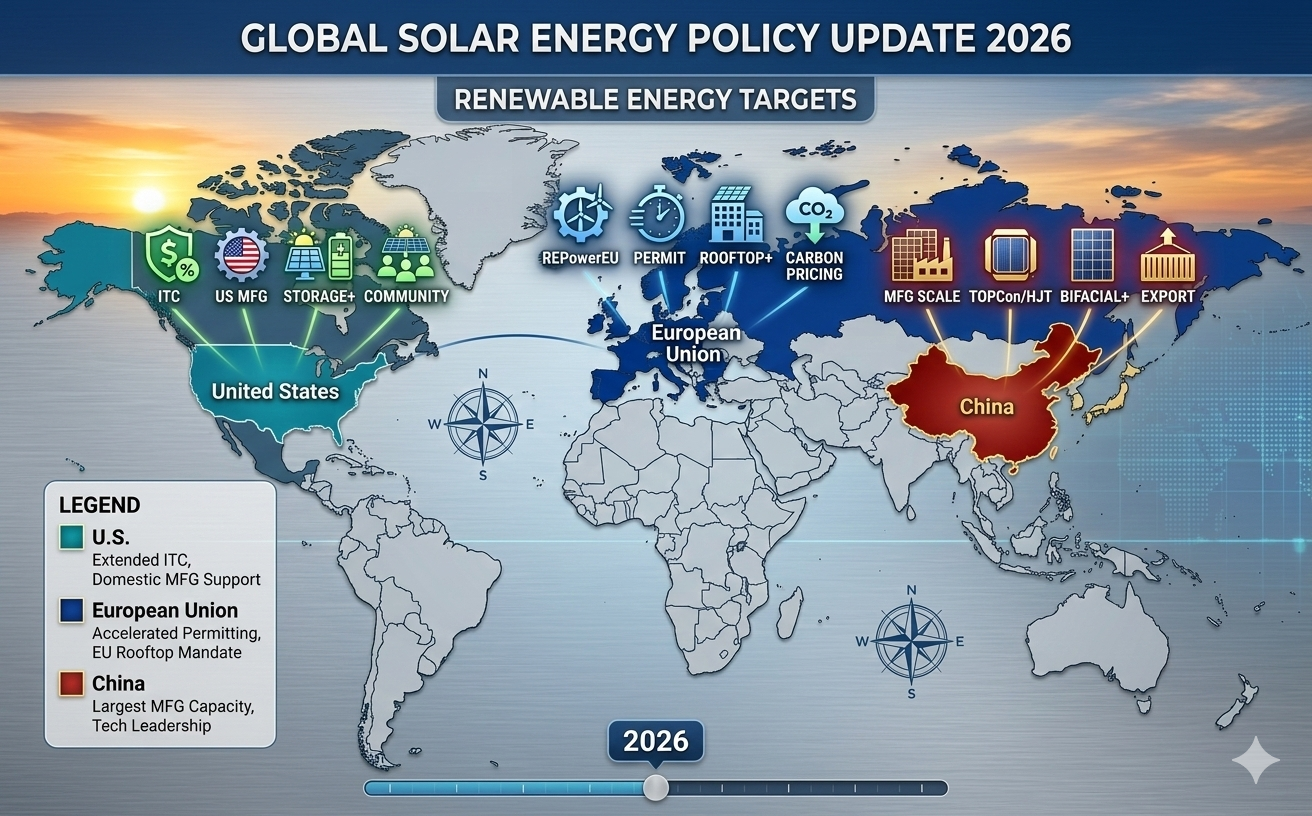
1. United States: Long-Term Stability for Clean Energy Investment
In the United States, the landmark legislation known as the Inflation Reduction Act continues to shape solar deployment in 2026.
Key highlights include:
Extended Investment Tax Credits (ITC) for solar installations
Manufacturing tax incentives for U.S.-based panel production
Energy storage incentives tied to solar systems
Community solar expansion support
These measures provide long-term visibility for installers and manufacturers, strengthening the domestic solar panel manufacturing ecosystem while reducing reliance on imports.
2. European Union: Energy Security & Carbon Neutrality
The European Union continues pushing forward with its REPowerEU strategy to accelerate clean energy independence.
Major policy focuses in 2026:
Faster permitting for utility-scale solar projects
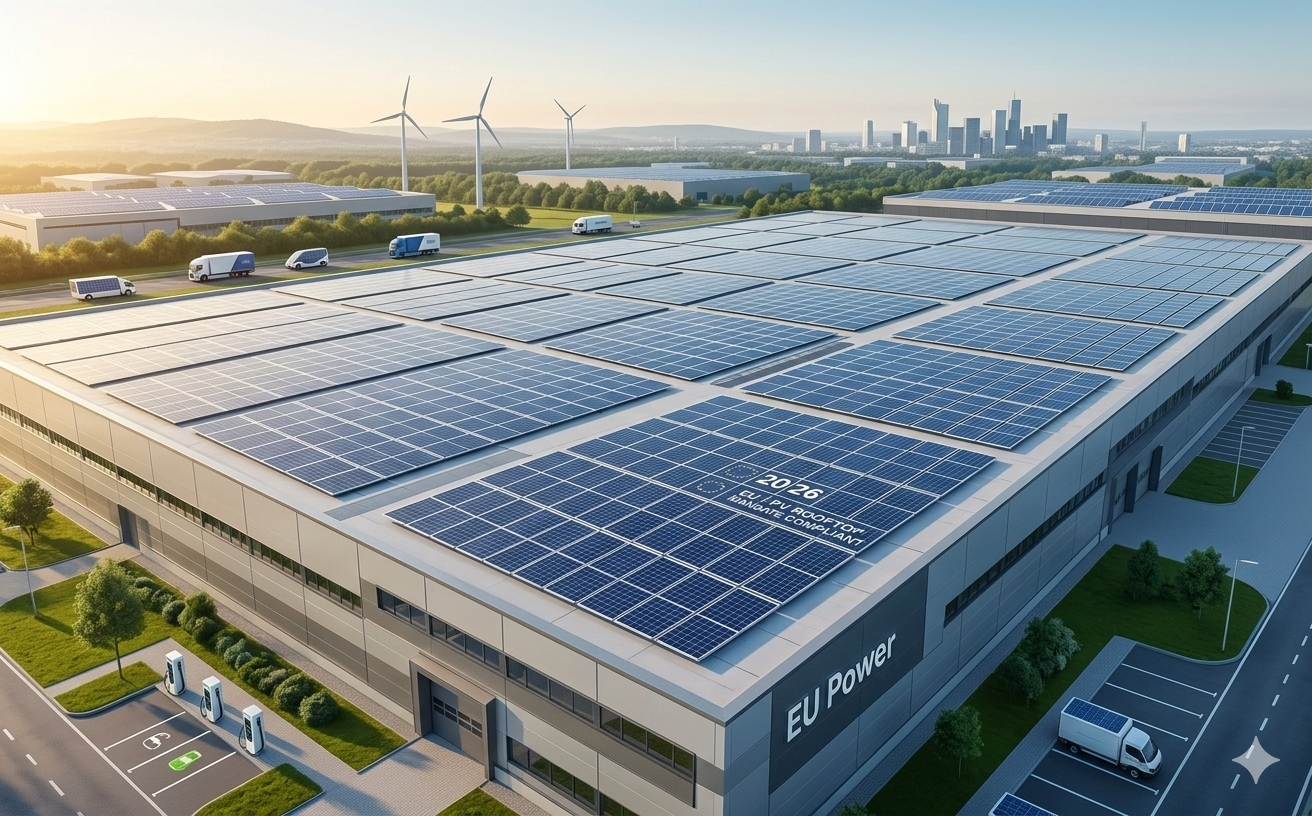
Mandatory rooftop solar for new commercial buildings
Increased funding for solar-plus-storage systems
Carbon pricing adjustments to encourage renewable transition
Europe’s approach directly supports growth in residential solar, commercial rooftop systems, and grid-scale photovoltaic installations.
3. Asia-Pacific: Manufacturing Scale & Export Growth
China, India, South Korea, and Southeast Asia continue scaling solar manufacturing capacity in response to global demand. Export-oriented factories are focusing on:
High-efficiency monocrystalline modules
TOPCon and heterojunction cell technologies
Bifacial solar panel production
Flexible and foldable solar panels
With strong policy backing, Asia remains central to the global photovoltaic supply chain.
4. Emerging Trends Shaping the 2026 Solar Market
Beyond national policies, several structural trends are influencing the global solar market:
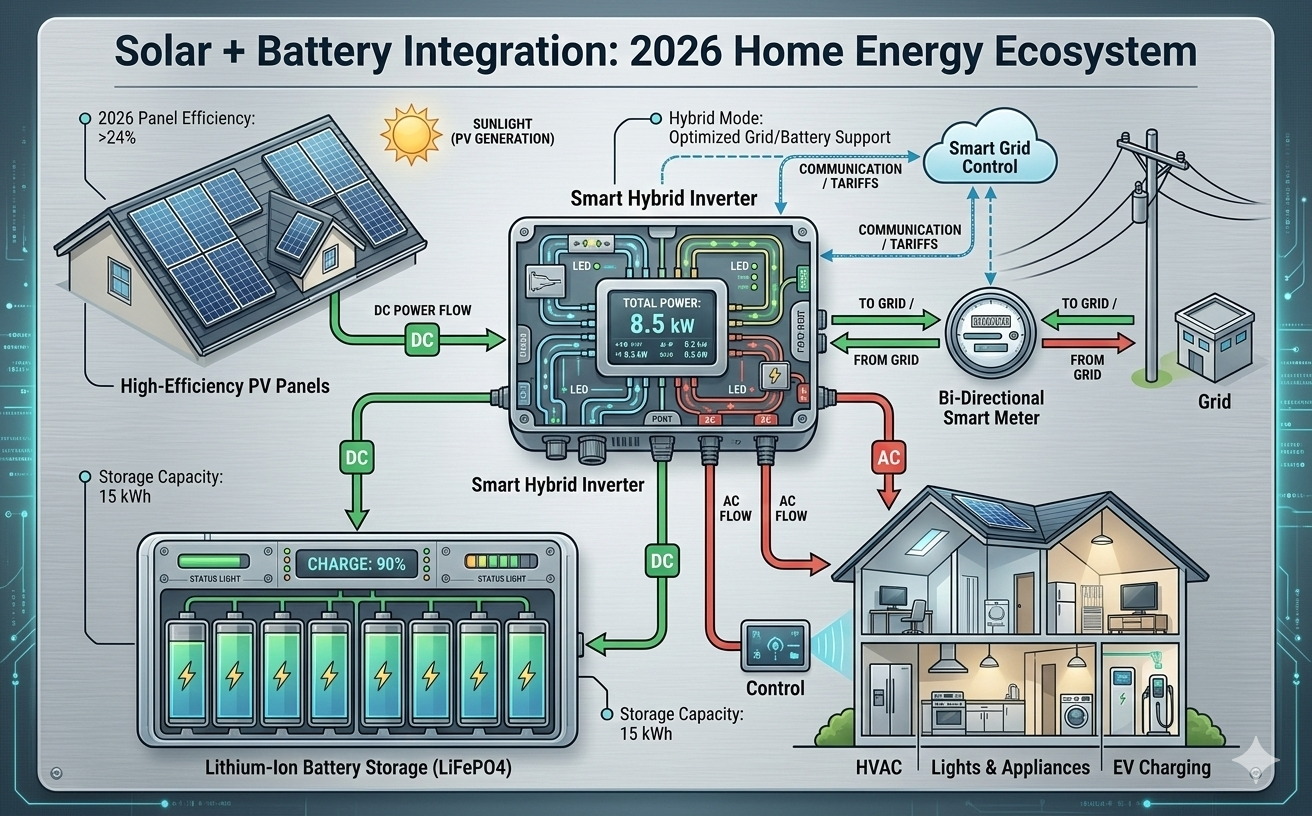
• Solar + Energy Storage Integration
Battery storage is now frequently included in incentive programs.
• Domestic Manufacturing Incentives
Governments are encouraging local solar module production.
• ESG & Corporate Decarbonization
Corporations are signing long-term Power Purchase Agreements (PPAs).
• Grid Modernization
Smart inverters and hybrid solar systems are becoming policy-supported technologies.
What This Means for Solar Buyers & Distributors
For international buyers and distributors, 2026 presents strong growth opportunities:
Higher demand for high-efficiency solar panels
Increased interest in off-grid and hybrid solar systems
More government-funded solar tenders
Growing demand for certified and bankable suppliers
Partnering with experienced manufacturers ensures compliance with regional certifications such as CE, UL, and IEC standards.
Outlook for the Renewable Energy Industry
The global renewable transition is accelerating. The solar industry is no longer subsidy-dependent but policy-supported and market-driven.
By aligning production with evolving energy policies, manufacturers and EPC contractors can position themselves for sustained long-term growth in the clean energy economy.
Conclusion
The 2026 solar policy updates across major economies are creating a more stable and expansion-oriented environment for the global solar market. With incentives supporting both deployment and manufacturing, solar energy continues to lead the renewable energy transformation worldwide.
For distributors, EPC companies, and project developers, staying informed about policy trends is critical to capturing new business opportunities.