


Solar Cell Technology Comparison in the Solar Industry
The global solar industry is rapidly evolving, with high demand for high efficiency solar modules. Understanding the solar cell technology comparison between PERC (P-type) and TOPCon (N-type) solar cells is essential for investors, EPC contractors, and distributors seeking competitive advantages in the renewable energy sector.
The latest global solar market trends indicate that TOPCon adoption is accelerating, especially in utility-scale projects and commercial solar farms.
What Is PERC Solar Cell Technology?
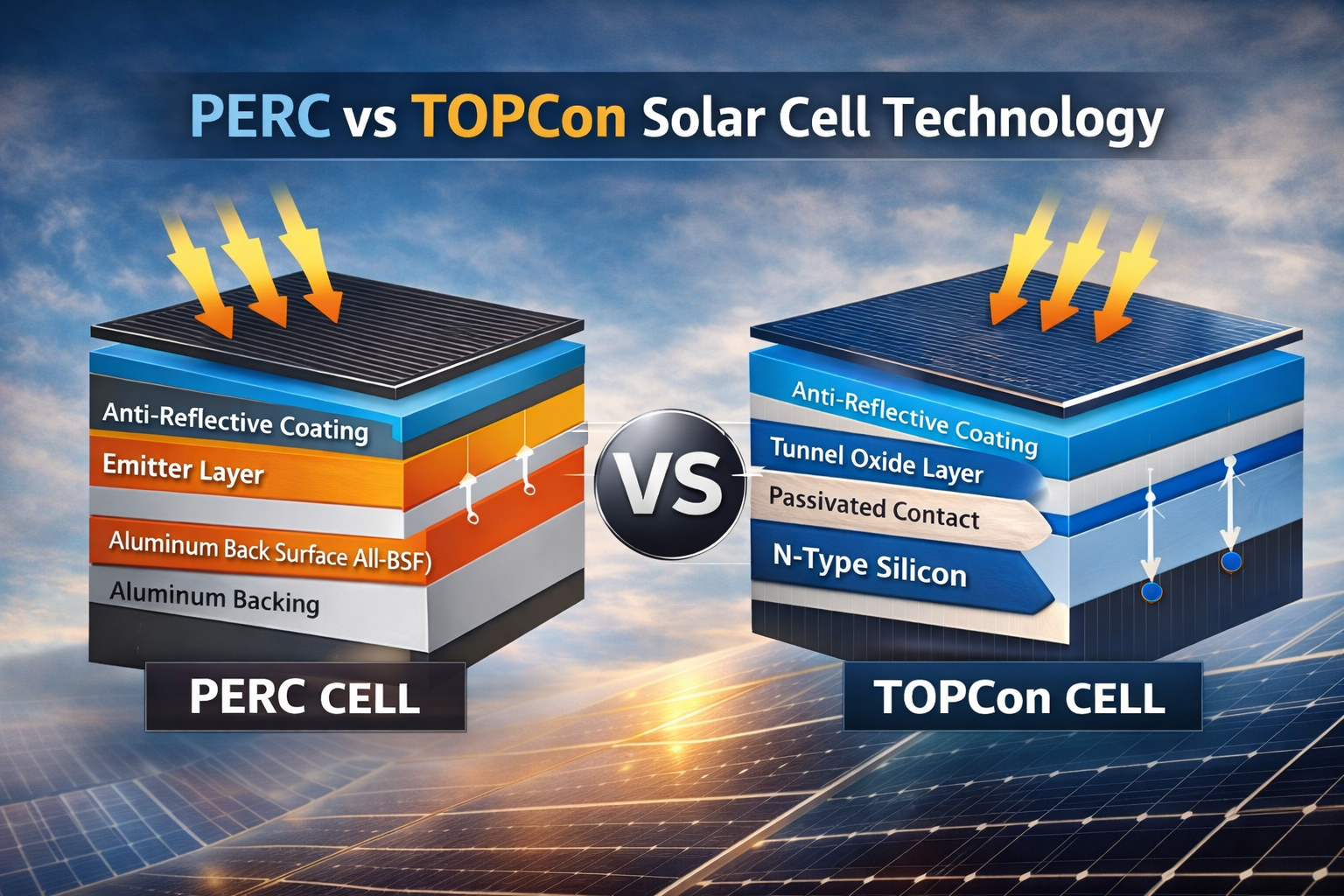
PERC (Passivated Emitter and Rear Cell) technology improves traditional P-type solar panels by adding a passivation layer on the rear side.
Key Features of PERC:
Improved light reflection and absorption
Higher solar module efficiency than conventional cells
Mature manufacturing process
Widely adopted in the global solar market
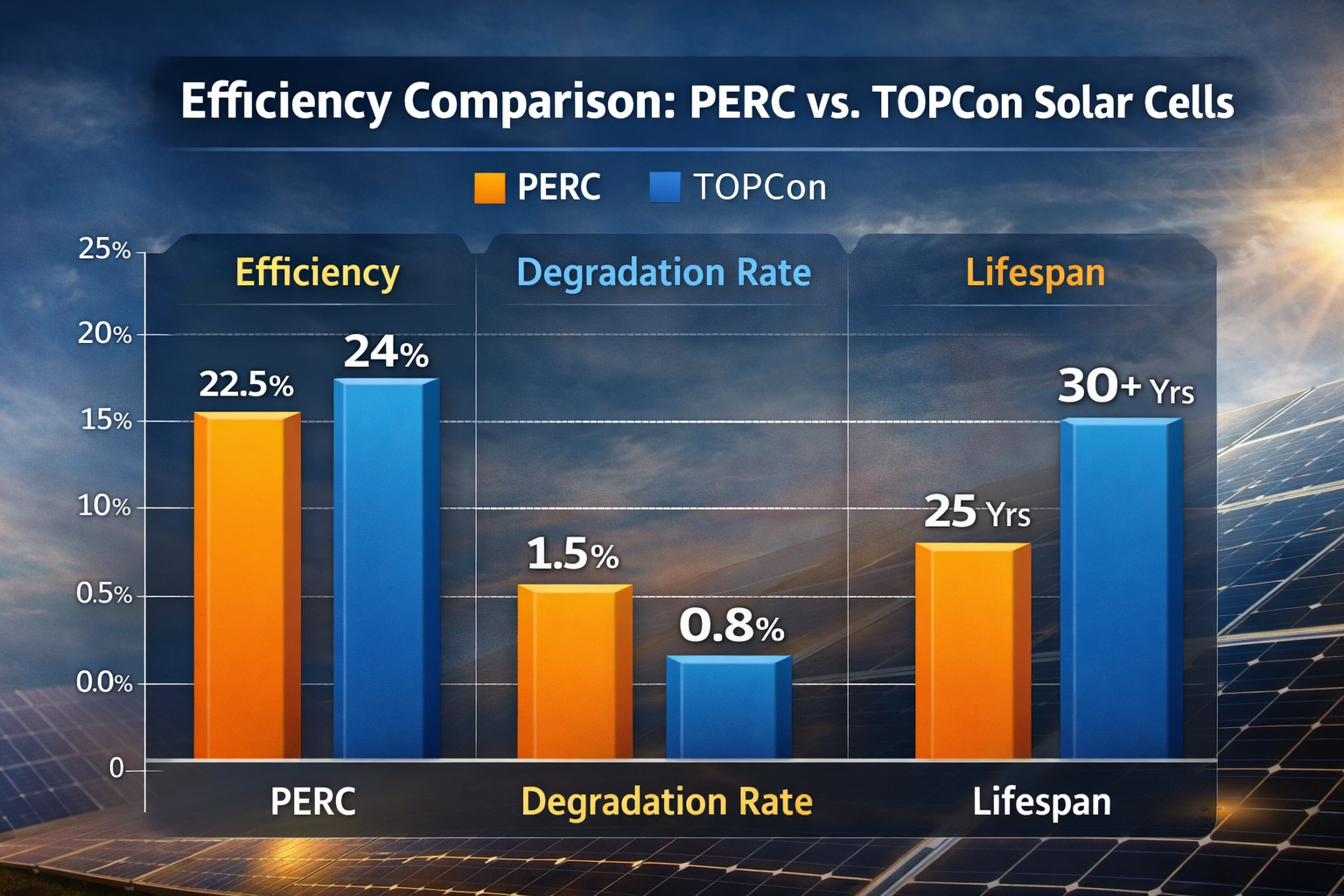
PERC cells typically reach efficiencies between 21%–23%, making them the mainstream solution over the past decade in the solar industry. However, their performance is approaching the theoretical limit, prompting a shift to next-generation cells.
What Is TOPCon Solar Cell Technology?
TOPCon (Tunnel Oxide Passivated Contact) is a next generation solar cell technology using N-type silicon to enhance carrier selectivity and reduce recombination losses.
Key Advantages of TOPCon:
Higher conversion efficiency (23%–25%+)
Better low-light performance
Lower solar panel degradation rate (resistant to LID & PID)
Longer lifespan for renewable energy investment
TOPCon modules are driving growth in the utility scale solar technology market, especially in Europe and North America.
TOPCon vs PERC: Key Differences
| Feature | PERC | TOPCon |
|---|---|---|
| Cell Type | P-type | N-type |
| Efficiency | 21–23% | 23–25%+ |
| Degradation | Higher LID | Lower LID, better solar panel degradation rate |
| Manufacturing Cost | Lower | Slightly Higher |
| Market Trend | Mature | Rapid Growth, aligned with global solar market trends |
In terms of solar module efficiency 2026, TOPCon is expected to outperform PERC, making it ideal for utility-scale and commercial solar projects.
Performance in the Solar Market
In the competitive solar market, TOPCon modules provide:
Higher power output per square meter
Better temperature coefficient
Improved long-term energy yield
PERC remains cost-effective, but next generation solar cells like TOPCon are increasingly preferred for high-efficiency solar installations and renewable energy investment projects.
Industry Trends: Is TOPCon Replacing PERC?
Current global solar market trends show manufacturers upgrading from PERC to TOPCon due to:
High solar module efficiency 2026 requirements (600W+ modules)
EU carbon neutrality policies
U.S. Inflation Reduction Act incentives
Increasing renewable energy investment
By 2026–2028, TOPCon is expected to dominate new capacity expansions, while PERC remains suitable for cost-sensitive regions.
Which Technology Should You Choose?
Choosing between TOPCon and PERC depends on project type:
Utility-scale solar farms: TOPCon preferred for maximum ROI and high efficiency solar modules
Commercial rooftops: TOPCon for stronger energy yield
Residential projects: Both N-type and P-type solar panels are viable
Budget-driven projects: PERC remains practical
For EPC companies and distributors, TOPCon offers stronger long-term competitiveness in the renewable energy market.
Conclusion
As the solar industry enters a high-efficiency era, TOPCon technology surpasses PERC in solar module efficiency, degradation rate, and long-term reliability.
Investors and solar developers focusing on next generation solar cells, utility scale solar technology, and renewable energy investment should consider TOPCon to align with the latest global solar market trends.