


Solar Industry Trends & Growth Forecast
The solar industry is entering a new phase of accelerated global expansion. Driven by government policies, declining technology costs, and growing demand for renewable electricity, the global solar market is expected to reach record levels in 2026.
Industry analysts predict that solar power will remain the fastest-growing renewable energy source worldwide. As countries work toward carbon neutrality and energy security, solar installations continue to expand across residential, commercial, and utility-scale sectors.
For companies and investors, understanding the global solar market outlook 2026 is essential for identifying new opportunities in the rapidly evolving solar industry.
Rapid Growth in the Global Solar Industry
The past decade has witnessed remarkable growth in solar deployment. Global installed solar capacity has increased dramatically as technology improvements and manufacturing scale have significantly reduced the cost of solar power generation.
Many energy agencies expect global solar capacity to exceed several terawatts by the end of the decade. Countries such as the United States, China, Germany, India, and Spain continue to lead in new solar installations.
Key drivers of solar industry growth include:
Government renewable energy incentives
Falling solar panel production costs
Growing corporate demand for clean electricity
Expansion of large-scale solar power plants
Rapid development of high-efficiency solar modules
As a result, solar energy is becoming one of the most competitive sources of electricity in the global energy market.
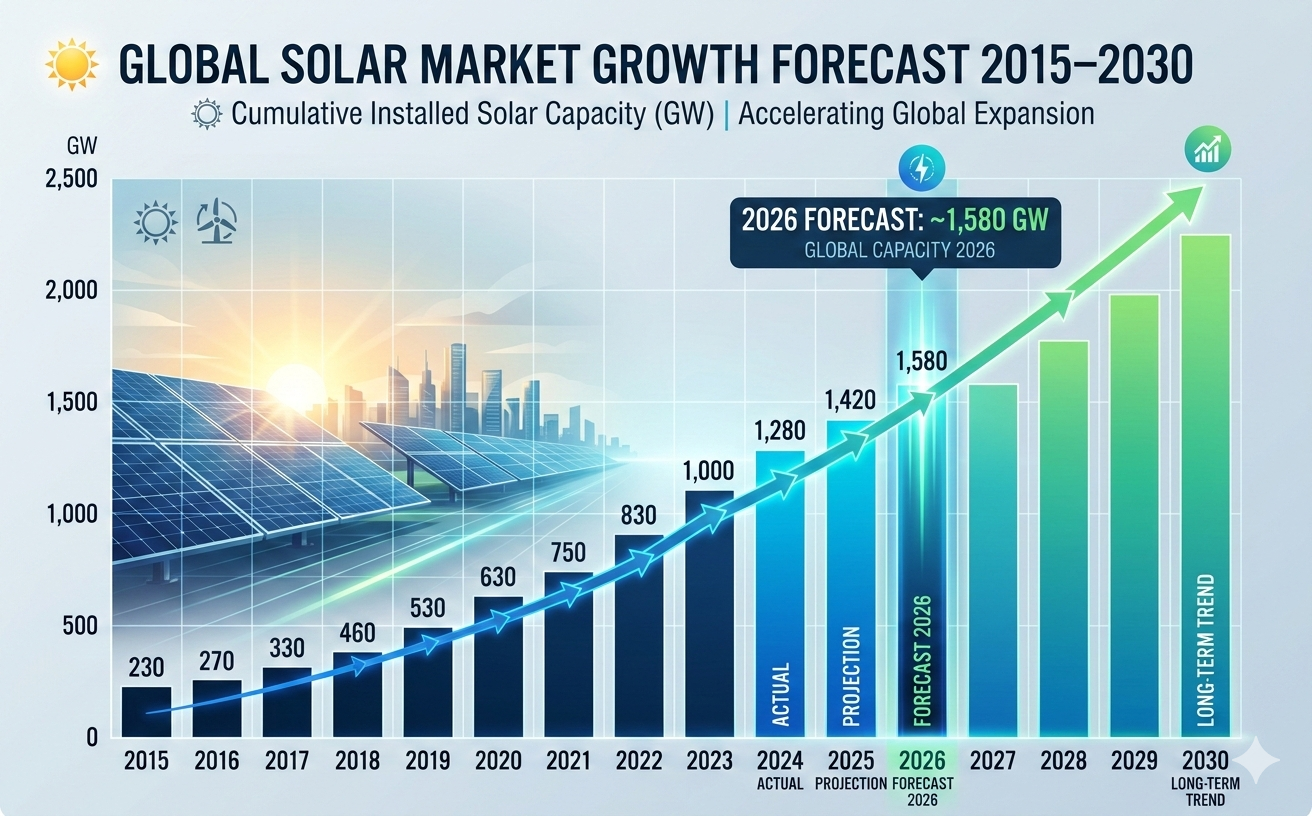
Image suggestion: A chart showing global solar capacity growth from 2015 to 2030 with projections for 2026.
Utility-Scale Solar Driving Market Expansion
One of the biggest contributors to solar industry expansion is the rapid development of utility-scale solar power plants. Large solar farms are now being built across multiple continents to support national clean energy targets.
Utility solar projects offer several advantages:
Lower electricity generation costs
Large-scale renewable energy production
Grid stability with integrated storage systems
Reduced carbon emissions
Countries with large land availability are particularly investing in massive solar farms capable of producing hundreds of megawatts of electricity.
These projects are expected to represent a significant share of global solar capacity growth in 2026.
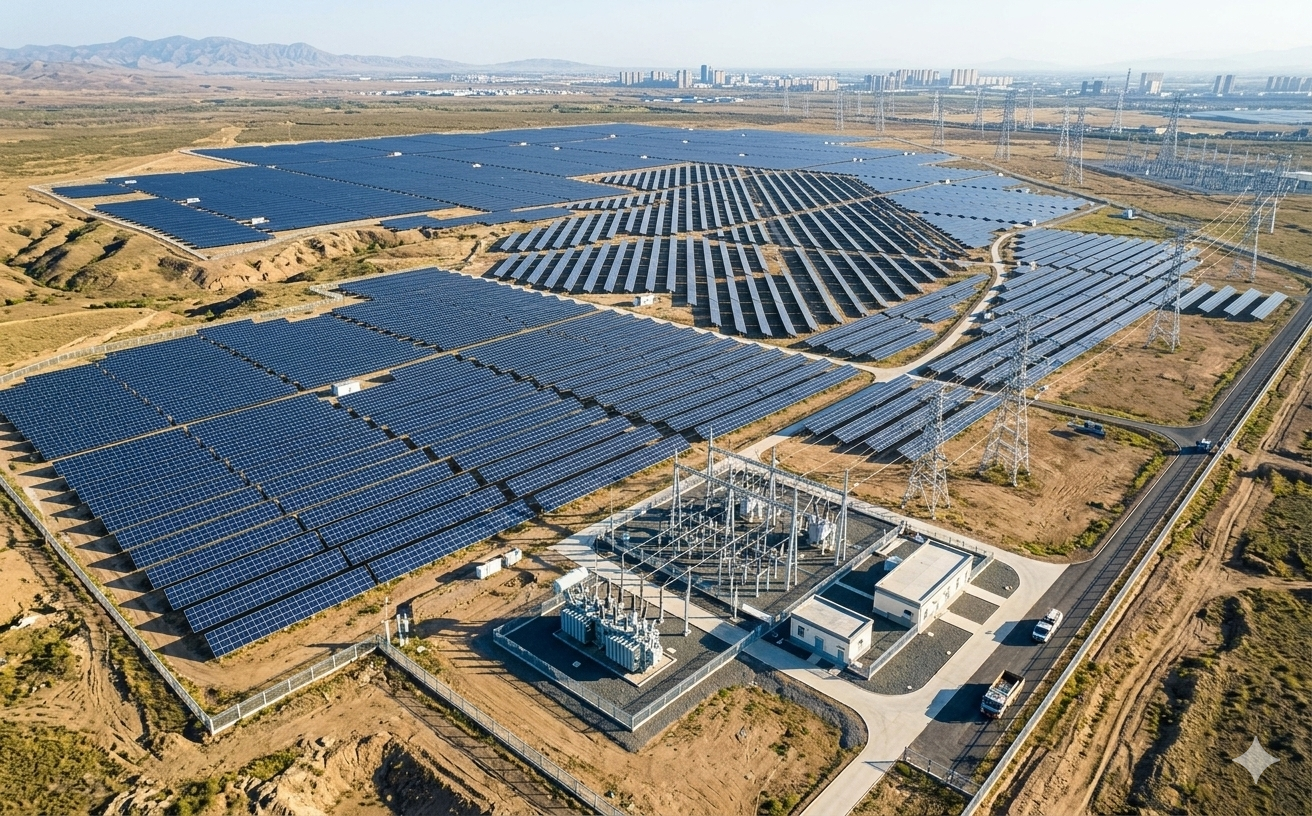
Image suggestion: Aerial view of a large solar farm with thousands of photovoltaic panels connected to grid transmission lines.
Technology Innovation Boosting Solar Efficiency
Technological innovation continues to play a crucial role in shaping the future of the solar industry. New solar cell technologies are improving efficiency while reducing long-term performance degradation.
Several advanced technologies expected to dominate the market include TOPCon solar cells and next-generation photovoltaic technologies. To learn more about these technologies, read our detailed comparison of TOPCon vs PERC Solar Technology:
TOPCon solar cells
HJT solar technology
High-efficiency N-type solar modules
Bifacial solar panels
Smart solar tracking systems
These innovations allow solar panels to generate more electricity with the same surface area. For a deeper understanding of photovoltaic performance, you can read our guide on Solar Panel Efficiency Explained., making solar energy even more cost-effective.
In 2026, manufacturers are focusing on producing high-efficiency solar modules capable of delivering greater performance in both residential and large-scale solar installations.
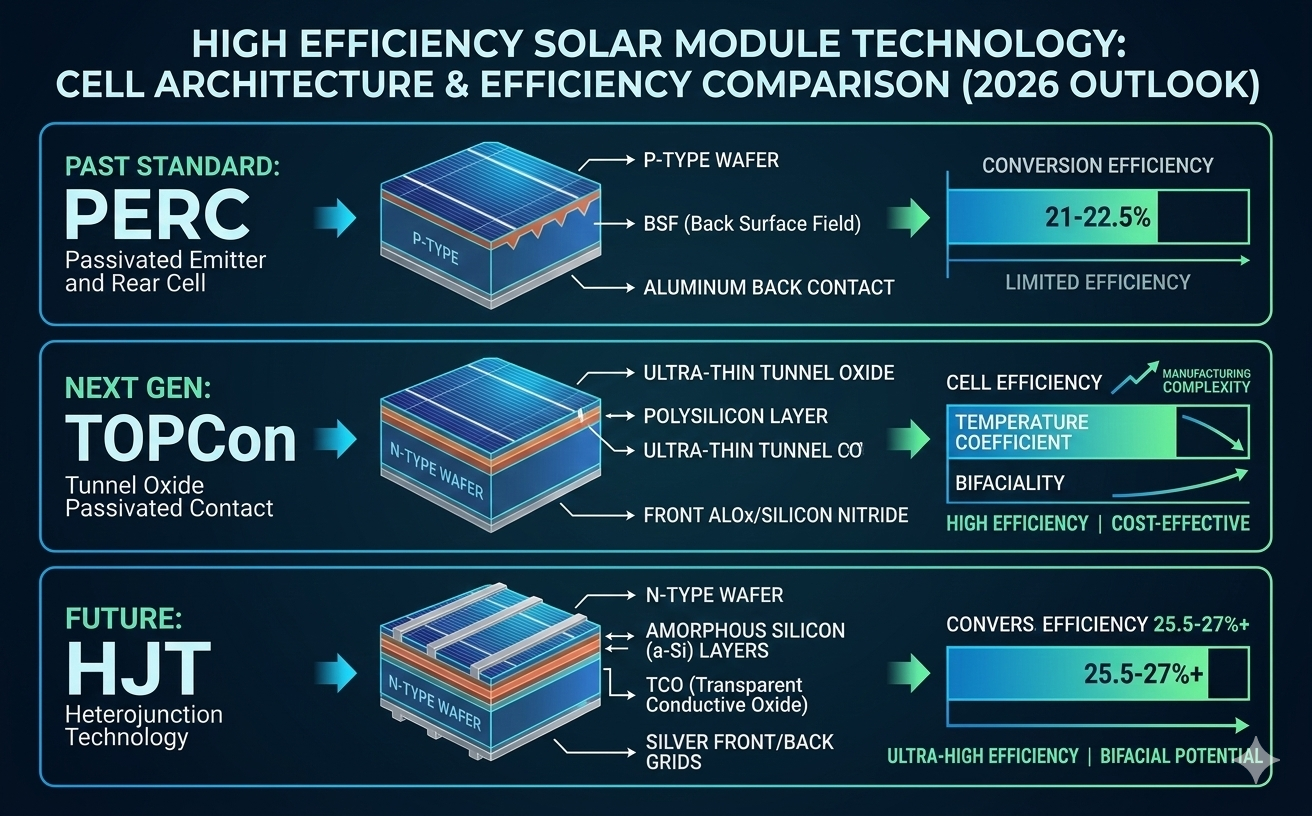
Image suggestion: Technical diagram comparing PERC, TOPCon, and HJT solar cell efficiency levels.
Global Solar Investment Trends
Investment in the solar energy market continues to grow as governments and private investors accelerate the transition to clean energy.
Major investment trends include:
Large renewable energy infrastructure funds
Corporate solar power purchase agreements (PPAs)
Expansion of distributed solar systems
Hybrid solar plus battery storage projects
Financial institutions increasingly view solar projects as stable long-term assets due to predictable energy production and decreasing operational costs.
As renewable energy demand rises, solar investments are expected to remain one of the most attractive sectors within the global energy market.
Regional Solar Market Opportunities
Different regions are contributing to solar market growth in unique ways.
North America
Strong government incentives
Rapid growth in residential and commercial solar
Europe
Aggressive carbon reduction targets
High demand for energy independence
Asia-Pacific
Largest solar manufacturing base
Rapidly expanding solar power infrastructure
Middle East & Africa
High solar irradiance levels
Growing investment in mega solar farms
These regional developments are shaping the global solar industry landscape in 2026.
Future Outlook for Solar Energy
Looking ahead, the solar industry is expected to maintain strong momentum through 2026 and beyond. Continued innovation, supportive government policies, and rising demand for clean electricity will drive further expansion.
Key future trends include:
Increased integration of solar energy systems combined with battery storage is becoming a key trend. Learn more in our article Solar Battery Storage Explained
Expansion of distributed rooftop solar
Development of ultra-high efficiency photovoltaic technologies
Growth of smart grid connected solar infrastructure
As the world transitions toward sustainable energy systems, solar power will play a central role in global electricity generation.
For businesses, energy developers, and investors, the global solar market outlook for 2026 presents significant opportunities across manufacturing, project development, and renewable energy investment.